Journal Menu
About this Journal
Find Issues
For Contributors
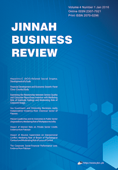
Latest Journal Issue
Date: July 2026 | |||||
Volume No: 14 | |||||
Issue No: 2 | |||||
Online ISSN: 2307-7923 | |||||
Print ISSN: 2070-0296Download Volume No. 14, Issue No. 2 |
About JBR
The Jinnah Business Review (JBR) is a Bi-annual academic research journal of the “Jinnah Business Research Center” of Capital University of Science & Technology, Islamabad (Pakistan). The journal publishes two issues every year, i.e. January and July. The Journal publishes theoretical and empirical research papers in management, finance, human resource management, marketing and economics, project management and technology, psychology, and all other related disciplines of management and social sciences.
Open Access Policy
All the articles published in JBR are under the terms of the Creative Commons Attribution (CC-BY) license. This license permits the available content to be copied, redistributed, and reused further in whole or part for any purpose for free, without any permission from the author(s) or publisher. All the work submitted to JBR for publication ensures CC-BY licensing terms.
Peer Review Policy
Articles submitted to JBR undergo a double-blind peer review process. An initial evaluation is conducted by the JBR working committee, comprising members from relevant disciplines. Manuscripts successfully passing this initial screening are then sent to two external reviewers for assessment. The Editor-in-Chief makes the final acceptance or rejection decision based on fairness and merit.
Jinnah Business Review Advertising Policy
Jinnah Business Review upholds the highest standards of academic integrity and editorial independence, in full accordance with the COPE Core Practices. To eliminate any potential or perceived conflict of interest, the journal operates under a strict no-advertising policy. We do not accept any form of commercial advertising, sponsored content, or promotional articles in our journal, on our website, or in any associated communications. Our editorial decisions are based solely on scholarly merit and are entirely free from commercial influence.